On this page
- What this generator actually does
- Feature versus benefit, and why the difference matters
- The facts the copy needs from you
- Writing for the marketplace and the brand page
- Search, honesty, and platform rules
- A worked example
- Common mistakes that cost sales
- Where this tool stops
- Anatomy of a high-converting product description page
- Search intent and structured keyword placement without stuffing
- Cross-border localization, WhatsApp catalogs, and mobile scannability
- Claim verification, accessibility, and legal compliance QA
- Sources and platform guidelines
What this generator actually does
This tool takes the facts you provide about a product and turns them into a first draft of a description. You supply a product name, an audience, the features and materials, the main customer benefit, and a preferred tone. The generator rearranges those inputs into a description a shopper can read and act on, then prints it on the same page.
The draft is a first pass, not a finished listing. Every marketplace applies its own rules to titles, claims, images, and prohibited categories. Every brand has its own voice. Every product has its own specifics that only the seller knows. The tool gives you a structured starting point so you spend your time editing for those specifics instead of staring at a blank box.
Everything on this page runs inside your browser. When you press the button, only an anonymous summary of your form fields is sent to a small serverless function that generates the draft and stops. No account, no login, no history. Nothing on our side records your product name, your features list, or the draft you received.
Feature versus benefit, and why the difference matters
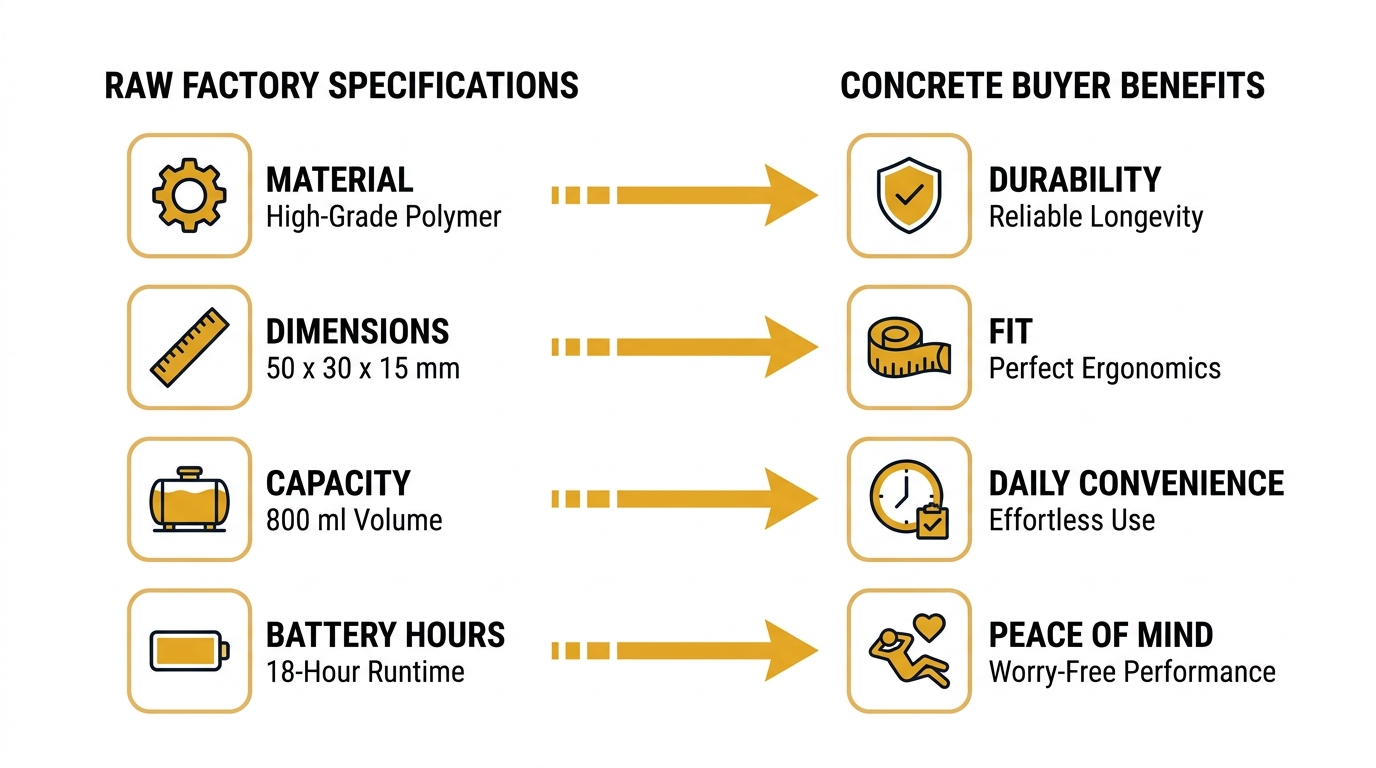
The single most useful distinction in product copy is the difference between a feature and a benefit. A feature is something the product has. A benefit is why the customer cares. A stainless steel bottle is a feature. A bottle that keeps water cold through a long commute is a benefit. Both belong in a description, but they do different work, and confusing them is the most common reason product pages read as dry lists of specifications.
The features section is where the buyer goes to verify. Capacity, materials, dimensions, colours, care instructions, and included parts are the details that answer the questions a shopper has after the photos have done their job. Put the specifics there and keep them accurate. "750ml capacity" and "double-wall stainless steel" mean something. "High quality materials" does not.
The benefit field is where the buyer decides whether the product is for them. It should describe a change the product actually supports, not a fantasy outcome. A desk organiser can keep frequently used items within reach. It should not promise to transform the way a person works. A skincare product can describe its texture and how it fits into a routine. It should not claim medical results unless those claims are supported by evidence and reviewed against the advertising rules that apply where you sell.
A useful test. Read the features list and ask whether a stranger could verify each line by looking at the product. If they could, the feature is doing its job. If they could not, the line is marketing and belongs in the benefit section, described carefully and honestly.
The facts the copy needs from you
The quality of the output depends entirely on the quality of the input. Feed the tool vague notes and you will get a vague description. Feed it real numbers, materials, and use cases and you will get a draft that a shopper could act on. There is no shortcut around that, and no amount of AI can invent specifics a seller has not provided.
For a physical product, the essentials are the name, the material construction, the dimensions or capacity, the colour and finish options, any included accessories or parts, the care instructions, and any certifications that matter to the buyer. For a digital product, the essentials are the format, the file size, the licence terms, the software or platform it is designed for, and any update or support policy. For a service, the essentials are the scope, the deliverable, the timeline, and the boundary of what is not included.
Keep the notes short and factual. You do not need to write full sentences. A comma-separated list of specifics gives the tool more to work with than a padded paragraph. If a product has a warranty, a return window, or a delivery promise, check the exact policy before you type it, because whatever you put in the form may end up in the draft and later on the page.
Writing for the marketplace and the brand page
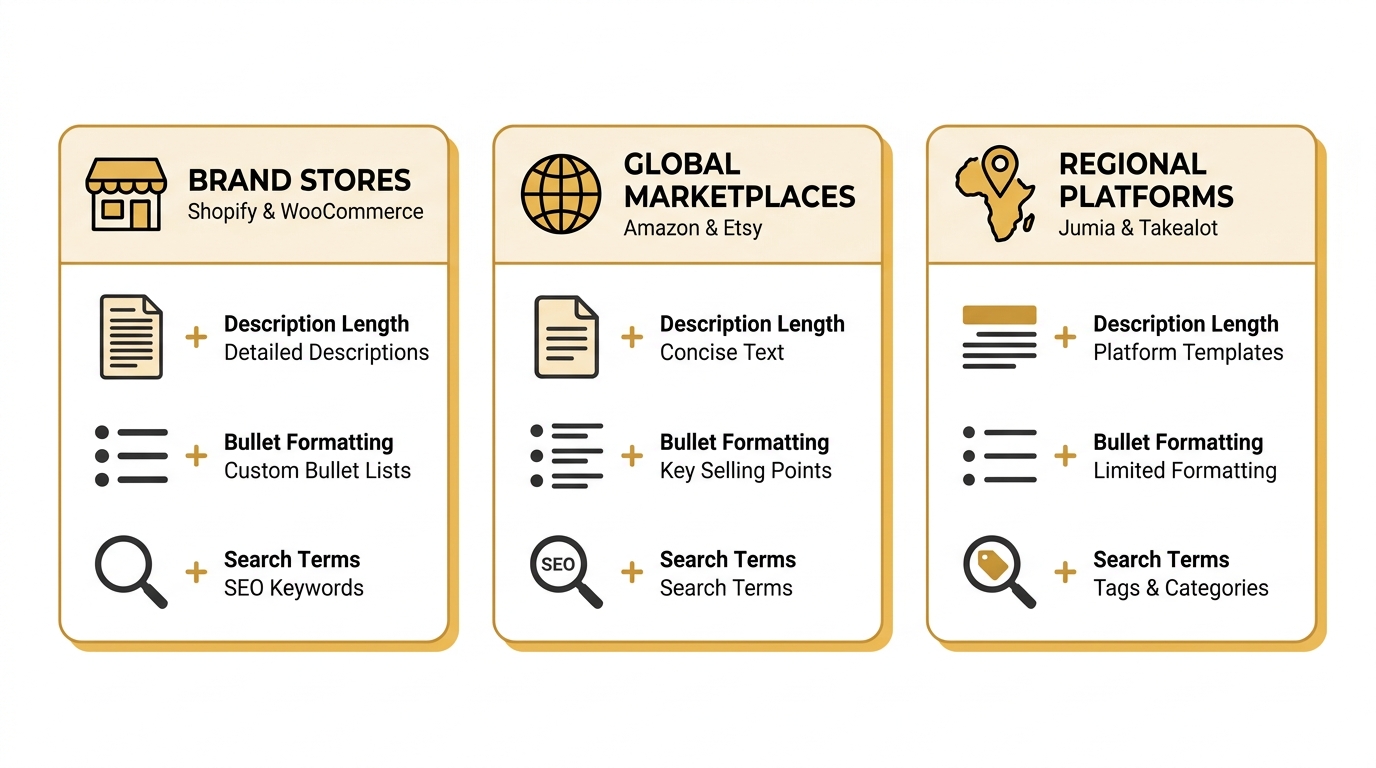
A product description is not one document. It is at least two, and sometimes three or four. Marketplace listings reward brevity because buyers compare quickly and the format is consistent across sellers. A brand's own product page can be longer because the reader has already chosen to look. A physical product insert or a package label has yet another register, because the reader already owns the product and is looking for care instructions rather than a pitch.
On a marketplace, the first two lines are the pitch. The rest is verification. A buyer scanning four similar listings will decide in about three seconds whether to read on. Put the clearest fact or benefit first, then the top two or three features, then close with the practical details. The tone should be plain. Clever headlines belong in advertising, not in a listing that has to survive translation into five languages and a text-only display on a mobile phone.
On a brand's own product page, you have more room. You can open with a short paragraph that sets the context, follow with a benefit-led bullet list, close with specifications and care instructions, and add an FAQ for the questions that come up most often. The tone can carry more of the brand's voice, because you control the environment. The same copy that reads well on Shopify may need to be trimmed for Amazon and expanded for a retail catalogue.
Keep a small notes file with the tone guidelines your brand uses. Two or three sentences about vocabulary, sentence length, and the words you avoid is enough. That file matters more than any single description, because it keeps the brand consistent across every product you sell.
Search, honesty, and platform rules
Search engines and marketplaces both reward useful content, and both punish filler. The honest move is to use the vocabulary a real buyer would type: the product name, the material, the use case, the size, the colour, and the compatible model where relevant. Put those terms where they belong, in a natural sentence, and do not repeat them in every paragraph hoping for a ranking bump.
Keyword stuffing does two things at once. It makes the description harder to read, which reduces conversion, and it can trigger marketplace penalties, especially on Amazon, where the listing rules on repeated words and prohibited claims are enforced. A description that reads as if a person wrote it, that answers a shopper's question, and that uses the right category and attribute tags, will usually outperform a longer description written for a robot.
The other honesty concern is the claim. Modern advertising rules in most countries, from the Federal Trade Commission in the United States to the Advertising Standards Authority in the United Kingdom, require that claims be truthful, not misleading, and supported by evidence. If you say a product lasts ten years, you need to be able to justify that. If you say it is the best on the market, you need to define what you are measuring. A careful paraphrase is one that would not embarrass you in front of a regulator, and the description draft is only the first of several steps toward that standard.
A worked example
Suppose a seller in Lagos is listing a reusable insulated water bottle aimed at commuters and gym members. She types the following into the form.
Product: reusable insulated water bottle. Audience: commuters, students, gym members in Lagos. Features: 750ml capacity, double-wall stainless steel, matte finish, screw-on lid with silicone seal, BPA-free, hand-wash recommended, comes in black and sand. Benefit: keeps drinks cold through a long commute. Tone: clear and persuasive.
A reasonable draft would open with the bottle and the commuter use case, follow with the capacity and construction, note the colours and included lid seal, mention the BPA-free material, close with a care note, and invite the buyer to check the size against their bag or cup holder. Nothing exaggerated. Nothing invented. Every claim traceable back to the form.
Now suppose the same seller is listing for a premium retail catalogue rather than a marketplace card. She would choose the premium tone and slightly longer sentences, and she might add a line about the matte finish catching the light. She would keep the same facts and the same honesty. The register shifts, the substance does not.
Common mistakes that cost sales
The same handful of mistakes show up on product pages everywhere, and they cost more than most sellers realise.
Leading with adjectives instead of facts. "Premium quality, high performance, best in class" tells a shopper nothing. A specific material, size, or use case gives them something to compare against.
Hiding the practical details. If the bottle is not dishwasher safe, say so. If the dress runs small, say so. If assembly is required, say so. The buyer finds out eventually, and the review they leave will be honest about it.
Overpromising on the benefit. Claims that cannot be supported are a legal risk and a customer trust risk at the same time. Keep the benefit to a realistic change, and let the features carry the weight.
Copying a competitor's description. Marketplaces notice duplicate text, search engines do too, and the copy rarely fits a different product as well as it fits the original.
Ignoring the mobile layout. Most shoppers read on a phone. Long paragraphs scroll off the screen, bullet lists read better, and the first two lines carry the whole pitch.
Forgetting the call to action. A description should end with something the buyer can do: check the size chart, message a question, add to cart, or read the FAQ. An open-ended ending lets the shopper drift to the next listing.
Assuming the draft is finished. It never is. The generator gives you a clean first pass. The product facts, the brand voice, and the compliance check all come from you, and they are what turns a draft into a listing that sells.
Where this tool stops
This tool produces a first draft. It does not check whether your product description complies with marketplace rules, advertising standards, or consumer protection law. It does not know the exact listing format the platform you sell on requires, and it does not verify the facts you supply. Those checks belong to the seller, and no tool can take them over without also taking over the responsibility that goes with them.
It also does not know your brand voice, your competitors, or the specific audience you are trying to reach on a given platform. It works from the notes you give it. If those notes are incomplete, the draft will be incomplete, and no amount of polish will fix a description that is missing the specifics a buyer needs.
What the tool gives you is a faster start. A structured draft that respects the reader, so you spend your time on the two things that only the seller can do: getting the facts right and taking responsibility for the claim. The last pass is yours, and it should be. A product description that has been read aloud, checked against the specifications, and adjusted for the specific marketplace it lives on is a better listing than one that came straight out of a text box.
Anatomy of a high-converting product description page
Buyers on mobile devices rarely read product pages top-to-bottom like an essay. Eye-tracking and scroll studies consistently show that shoppers scan the primary image, check price and delivery speed, read the first two headline sentences, jump straight into bulleted specifications, and pause at warranty or sizing notes right before tapping Add to Cart. Structuring your edited AI draft into five purposeful visual blocks serves both impatient skimmers and detail-driven researchers:
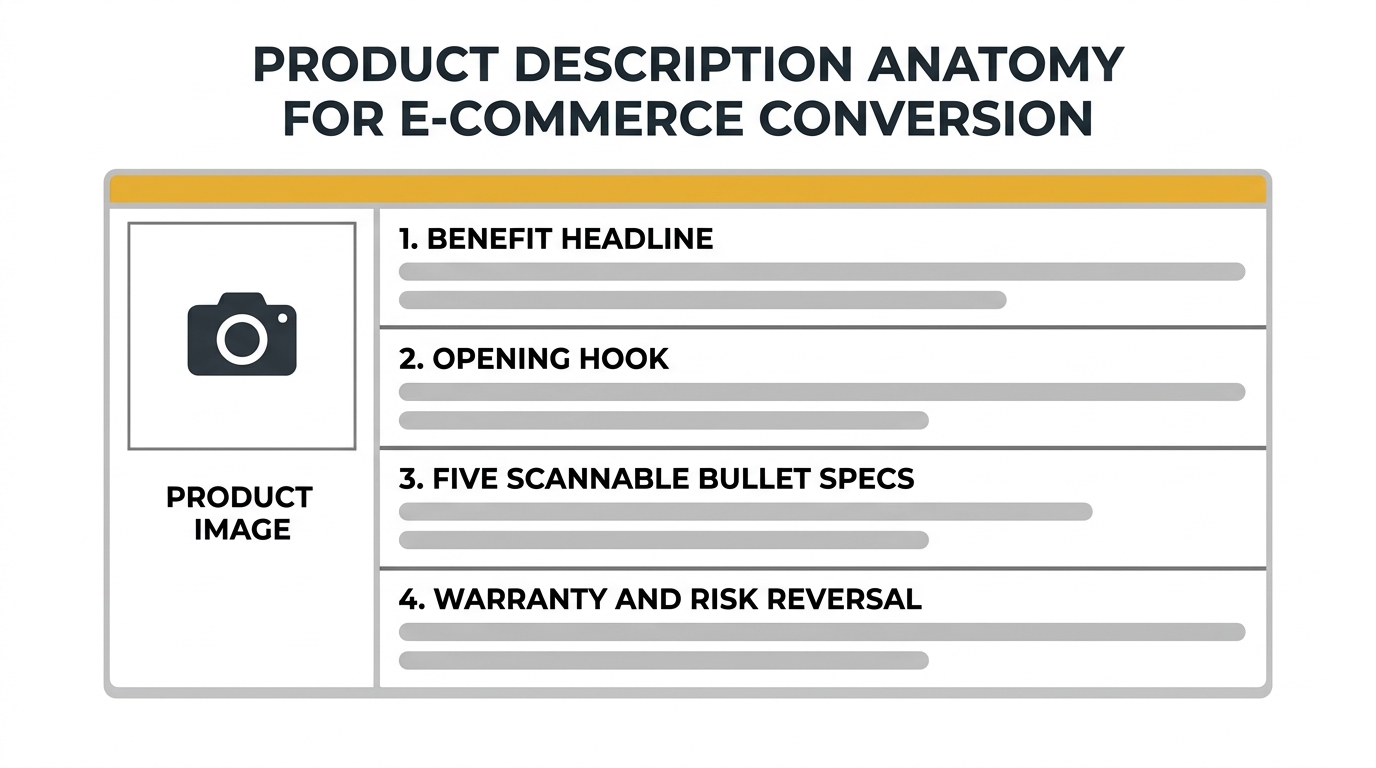
- Benefit-led title modifier (6–12 words): Pair exact product category identification with the defining use case or key technical attribute (for example, "Leakproof 750ml Insulated Gym Bottle with Chug Cap" rather than vague lifestyle slogans).
- Two-sentence opening hook: Name clearly who the product solves a problem for and why your build prevents a frustrating failure mode such as zipper splits, condensation sweat, fabric pilling, or rapid battery fade.
- Five scannable benefit-first bullets: Lead each bullet with a bold two-to-four-word buyer outcome followed immediately by the concrete specification that earns trust—shell material, exact stitch count, milliampere-hour capacity, wattage, or weight limit.
- Box contents & compatibility matrix: List every included cable, spare gasket, adapter, or care cloth explicitly—plus device models or plug standards the unit does not fit—cutting pre-checkout questions and preventable return-shipping losses by double digits.
- Warranty, returns, and dispatch clarity: State return windows, replacement guarantees, and dispatch cutoffs cleanly directly beside payment icons rather than burying policy reassurance in footer legal links.
Search intent and structured keyword placement without stuffing
Ranking product pages in organic Google search, Shopify internal search, and marketplace algorithms relies on unambiguous attribute vocabulary, not repeating a main phrase ten times inside two paragraphs. Shoppers type concrete modifier patterns specifying material (100% linen, borosilicate glass), capacity (20L cabin backpack), recipient (for sensitive scalp, for wide feet), or standard (USB-C PD 65W).
- Anchor canonical search intent smoothly once or twice: Use your clearest primary product term inside the title tag, page H1, and first hook sentence while preserving natural rhythm.
- Distribute secondary attributes across individual bullets: Instead of forcing five awkward synonyms into the opening paragraph, place authentic secondary search modifiers—weights, safety standards, care instructions, and compatible models—cleanly within dedicated bullet specifications.
- Audit finished drafts before catalogue uploads: Paste completed product descriptions through our Keyword Density Checker to catch repetitive clichés, generate tight click-worthy meta snippets with the SEO Meta Generator, and verify healthy post-ad gross unit margins using our Profit Margin Calculator and Pricing Calculator.
Cross-border localization, WhatsApp catalogs, and mobile scannability
Merchants selling simultaneously across domestic high-street buyers, African social-commerce messaging channels, and international marketplaces must tailor product copy intentionally for bandwidth constraints, measurement conventions, and local trust friction:
- Publish dual metric and imperial specifications: Express garment chest widths, luggage volumes, skillet diameters, and hardware cable lengths in both centimetres/litres/grams and inches/ounces (for instance, "18 cm × 12 cm / 7.1 in × 4.7 in"). Dual measurement eliminates sizing hesitation simultaneously across Lagos, Nairobi, London, Toronto, and Chicago shoppers.
- Format concise WhatsApp Catalog and Instagram Shop entries: Chat-commerce buyers frequently browse on mobile cellular links inside compact message previews. Lead WhatsApp Business catalog descriptions with clear currency pricing, stock availability, same-day dispatch cutoffs, and four compact line-broken highlights totaling 75 to 110 words—and issue itemized digital customer receipts rapidly with the Invoice & Receipt Generator.
- Respect the mobile 150-character preview fold: Many modern e-commerce themes fold product descriptions behind a "Show more" toggle after two lines on mobile screens. Front-load your single strongest differentiator plus essential sizing warnings within those opening 150 characters so fast buyers never miss dealbreaker facts.
Claim verification, accessibility, and legal compliance QA
Persuasive copy becomes expensive quickly if an unverified exaggeration triggers marketplace account holds, chargeback disputes, or consumer-protection penalties. Run this practical four-point pre-publish QA pass across every generated listing:
- Substantiate objective quantitative promises: Under US FTC endorsement rules and UK ASA CAP guidelines, measurable claims such as "keeps ice frozen 24 hours", "IP68 waterproof", or "cuts drying time in half" require documented factory test sheets or verifiable proof. Strip vague unprovable superlatives ("best on earth", "100% indestructible") before uploading.
- Avoid prohibited medical, therapeutic, and eco-washing phrases: Skincare oils, nutritional supplements, posture braces, and cleaning solutions must never claim to "cure", "prevent disease", or carry certified biodegradable labels without official regulatory clearance and test serial numbers.
- Maintain clean screen-reader accessibility: Avoid decorative unicode stars, split fake-bold Unicode characters, or all-caps paragraphs that screen readers struggle to vocalize cleanly; use clean HTML bullet lists, plain sentence case, and descriptive headings instead.
- Standardize variant tone across entire collections: When migrating dozens of supplier SKUs onto a unified brand storefront, polish repetitive vendor syntax with our AI Paraphrasing Tool and confirm consistent reading flow before going live.
Before-and-after e-commerce listing rewrite: electronics charger example
Compare how a vague generic draft fails buyers against a crisp structured specification edit built from real notes. A raw seller input that says "Fast charger, very strong, works on phones and laptops, black colour, nice design" yields thin puffery: "Experience ultra-fast charging performance with our sleek modern charger built for everyday devices." No shopper knows wattage, port count, safety chips, or regional plug shape—so hesitant buyers click back to competing listings.
Supplying specific facts produces conversion-ready structure: 65W GaN Dual-Port USB-C Wall Charger (UK/NG 3-Pin Plug) — Delivers full-speed 65W USB-C Power Delivery to charge a 13-inch laptop from 0 to 50 percent in 32 minutes while topping up a smartphone simultaneously on a secondary 18W USB-A port. Built with GaN thermal management to stay cool during humid commutes, certified to BS 1363 safety standards, and packaged with a braided 1.5-metre 100W USB-C cable backed by a 12-month swap warranty. Every line removes an objection while inviting natural buyer search keywords without fluff.
A/B testing two opening hooks without changing traffic
Once your storefront receives steady weekly product views, rotate only the first two headline sentences above the bullet specs for fourteen days while keeping photos, price, and ads unchanged—comparing problem-focused framing (such as leak elimination or time saved) against aspiration-focused framing while monitoring Add to Cart rate per product view.
Building reusable specification templates for growing product catalogues
Merchants managing forty to five hundred SKUs—such as skincare lines, footwear boutiques, hardware tools, or spare electronics components—waste dozens of hours drafting inconsistent copy item by item. Instead of starting fresh on every product, create one standardized bullet template per category defining five mandatory attribute slots in fixed order: core performance metric, primary material grade, exact physical measurements, compatibility or sizing guidance, and included warranty terms. Feeding structured bullet notes from that template into this generator ensures brand consistency across collections, speeds onboarding of new seasonal inventory, and prevents accidental omission of critical buyer specs that drive expensive customer support chats.
Sources and platform guidelines
Official Merchant & Regulatory Sources
- Shopify. Help Center — Product Descriptions, SEO, and Store Setup. help.shopify.com
- Amazon. Seller Central — Product Detail Page Rules and Style Guides. sellercentral.amazon.com
- Etsy. Seller Handbook — Listing Best Practices. etsy.com/seller-handbook
- Federal Trade Commission — United States. Advertising and Marketing Basics. ftc.gov/business-guidance
- Advertising Standards Authority — United Kingdom. The CAP Code: Non-broadcast Advertising Rules. asa.org.uk
- World Wide Web Consortium (W3C). Web Content Accessibility Guidelines (WCAG). w3.org/WAI