On this page
- What this planner actually builds
- The cognitive science behind the schedule
- How Canadian academic terms are structured
- How the allocation algorithm works
- A worked Ontario Grade 12 example
- A worked first-year university example
- Five mistakes that ruin a study plan
- Where this planner stops
- Provincial rules: Ontario 4U/4M, Alberta Diploma Exams, BC, and CEGEP
- Balancing part-time work, co-op terms, and Canadian winter commuting
- The 14-week term pacing and Reading Week exam taper playbook
- Active recall tactics by discipline: STEM vs. humanities & commerce
- Sources
What this planner actually builds
This tool takes a list of courses, the hours you realistically have available each week, and the days remaining until each course's next major assessment. It then distributes those hours across the courses according to three factors: how difficult each course is, how wide the gap is between your current average and your target, and how soon the next high-stakes deliverable sits on the calendar. The output is a weekly hour budget per course, a seven-day timetable that interleaves subjects, and a set of daily block targets that match whichever focus protocol you picked.
Nothing about this is a magic formula. The arithmetic is transparent and you can replicate it on paper in about ten minutes. What the planner adds is speed, a consistent weighting scheme, and a printable weekly view that keeps the plan visible on a wall or a second screen instead of buried in a notes app. It also splits the week so that no single subject dominates a day, because interleaving is one of the few study techniques with strong experimental support and it is also one of the easiest to skip when you are tired.
The downloadable PDF is the practical anchor of the tool. Plans that stay inside a browser tab tend to be forgotten by Wednesday. Plans that sit above a desk get used. The PDF is formatted as a single clean page with your week's hours, the per-course allocation, and the seven-day grid, and it prints in black, white, and yellow without any of the surrounding page furniture.
The cognitive science behind the schedule
Three research findings shape the algorithm, and none of them are new. The first is that distribution beats concentration. The same total study time produces substantially better long-term retention when it is spread across several days instead of concentrated into one block. This was first measured by Hermann Ebbinghaus in the 1880s and has been confirmed many times since, most thoroughly in the 2013 review by John Dunlosky and colleagues in Psychological Science in the Public Interest. The plan reflects this by scheduling each subject across multiple days in the week rather than stacking it into one or two long sessions.
The second finding is that retrieval beats review. Testing yourself with closed-book recall strengthens memory more than re-reading the same material. The 2006 study by Henry Roediger and Jeffrey Karpicke at Washington University in St. Louis is the standard reference here, and it is the reason the blueprint panel pushes flashcards and problem sets instead of highlighting and re-reading. The plan does not force you to use these methods, but the day-by-day cadence is arranged around the assumption that day three is for recall and day seven is for application.
The third finding is that interleaving beats blocking. When you practise several related topics in a mixed sequence rather than in contiguous blocks, you get better at distinguishing between them and at choosing the right approach when the problem is presented cold. Doug Rohrer and Kelli Taylor's 2007 paper in Instructional Science is the classic demonstration in mathematics education, and the same effect shows up in language learning and in procedural skills. The planner interleaves subjects within each day for this reason, even though the schedule looks slightly busier than a blocking approach would.
What this does not mean. Interleaving is not the same as multitasking. Switching between two subjects deliberately every hour is different from scrolling through four browser tabs while trying to study. The plan assumes a single block of focused attention on one subject at a time, with subject changes happening at block boundaries.
How Canadian academic terms are structured
Canadian education is governed at the provincial level, which means there is no single national term pattern. The five main structures the planner accounts for are set out below.
| System | Term shape | Assessment pattern |
|---|---|---|
| Ontario high school (OSSD, Grade 11 and 12) | Two semesters of four courses each, or four quadmesters of two courses | Continuous assessment with unit tests, a final culminating project, and a final exam worth up to 30 per cent |
| British Columbia (Grade 11 and 12, Dogwood Diploma) | Two semesters of four courses each, with provincial assessments in Literacy and Numeracy | Continuous assessment with a mix of tests, projects, and a Graduation Numeracy Assessment |
| Alberta (Grade 11 and 12, 30-level courses) | Two semesters of four courses each, diploma exams in 30-level core subjects | Continuous assessment with a diploma exam worth 30 per cent of the final blended mark |
| Quebec CEGEP | Two semesters per year, students typically take five or six courses | Continuous assessment feeding the R-score, with final exams at the end of each semester |
| Canadian university and college | Fall, Winter, and optional Summer terms, each with a midterm cluster and a final exam period | Two midterms and a final in most science and engineering courses; a midterm and final plus papers in most arts courses |
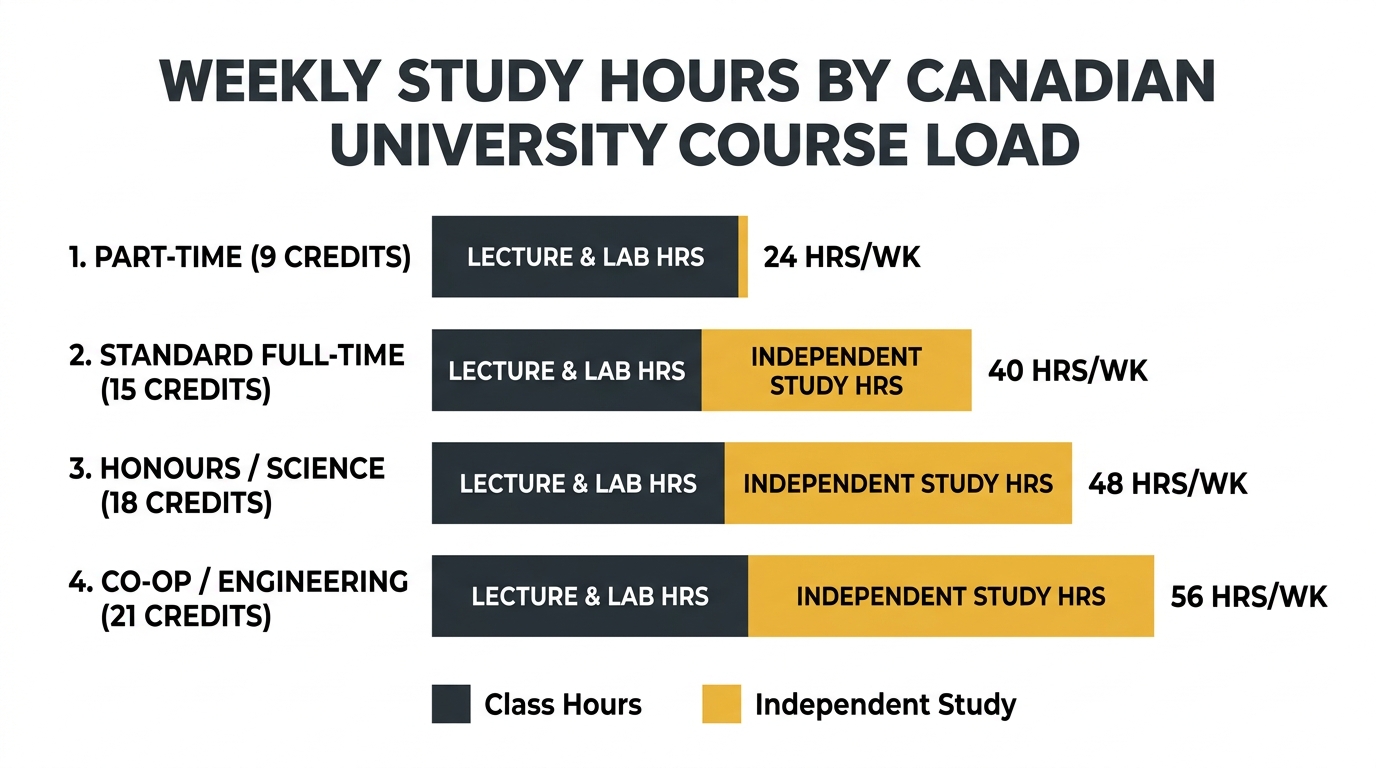
The distinction that matters most for planning is when the high-stakes deliverables sit. Alberta and Ontario high school courses tend to weight their final exams at twenty to thirty per cent, with the rest coming from continuous assessment. CEGEP courses weight continuous assessment more heavily because every mark contributes to the R-score. University midterms cluster in the second half of October and in mid-February, and reading week sits either side of that cluster depending on the institution. A plan that assumes a single big exam at the end of term will be wrong for most Canadian students, which is why the planner asks for the days remaining until the next major assessment rather than the end of term.
How the allocation algorithm works
The calculation has three inputs per course and produces one output: the number of hours per week that course should get.
Difficulty weight. Each course is tagged as low, moderate, high, or challenging. A challenging course, typically a lab science or an advanced mathematics sequence, carries a weight of 1.45. A high-difficulty course carries 1.25. A moderate course carries 1.00, and a low-difficulty course carries 0.80. The weight shifts the relative share but does not change the total.
Grade gap factor. The tool calculates the gap between the current average and the target. A five-point gap widens the course's share by roughly 7.5 per cent, a ten-point gap by about 15 per cent, and a fifteen-point gap by roughly 22 per cent. The effect is bounded, because a course where the student is already at the target still needs some attention, and a course where the student is far behind cannot absorb the whole week's hours without sacrificing everything else.
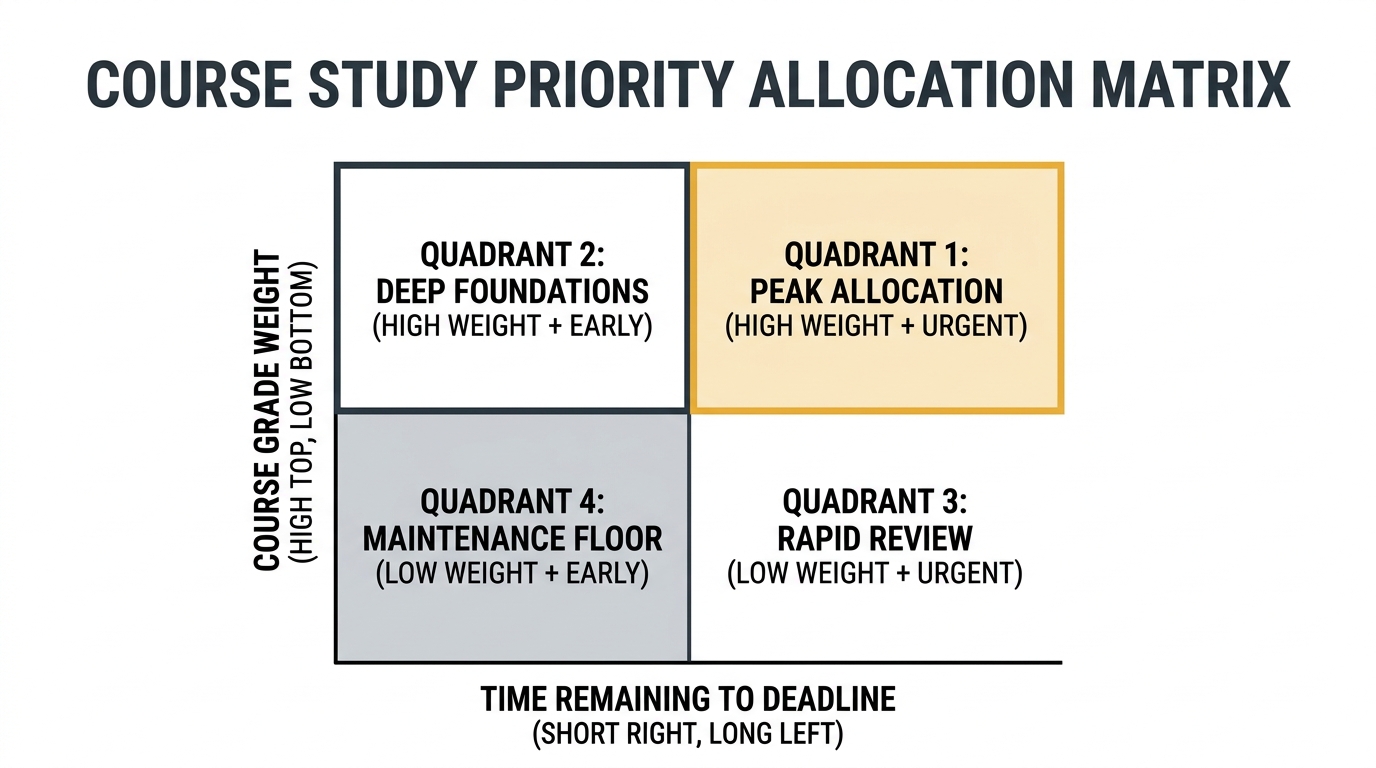
Urgency factor. The days remaining until the next major assessment determine how much the course's share is boosted in the current week. A course with an exam within seven days gets a 1.60 multiplier, within fourteen days gets 1.35, within twenty-one days gets 1.15, and beyond that sits at 1.00. The urgency boost is temporary, and the planner assumes you will re-run it every one to two weeks as assessments pass and new ones appear on the horizon.
The three factors multiply together into a raw score for each course, and the raw scores are then normalised so that the sum of all hours exactly equals the weekly budget you entered. Rounding is applied at the end so the total matches to one decimal place. The result is a distribution that puts more weight on courses that need more work, but that never starves any course entirely.
A worked Ontario Grade 12 example
Take a Grade 12 student in Ontario with four courses in the fall semester and twenty-four hours available each week for independent study. The four courses are MCV4U Calculus and Vectors, SPH4U Physics, SCH4U Chemistry, and ENG4U English. The student's current averages are eighty-four, eighty-six, eighty-eight, and ninety respectively, and their targets are ninety-four, ninety-two, ninety-two, and ninety-two. The next major deliverables sit at twelve days for calculus, sixteen days for physics, eight days for chemistry, and twenty days for English.
The raw scores come out approximately as follows. Calculus: difficulty 1.45 (challenging), gap factor 1.15 (ten-point gap), urgency 1.35 (twelve days) gives 2.25. Physics: difficulty 1.25, gap factor 1.09 (six-point gap), urgency 1.35 (sixteen days) gives 1.84. Chemistry: difficulty 1.25, gap factor 1.06 (four-point gap), urgency 1.60 (eight days) gives 2.12. English: difficulty 1.00, gap factor 1.03 (two-point gap), urgency 1.15 (twenty days) gives 1.18.
Summing the raw scores gives 7.39. Distributing the twenty-four-hour budget proportionally gives roughly 7.3 hours to calculus, 6.0 hours to physics, 6.9 hours to chemistry, and 3.8 hours to English. Rounded, that is about seven and a half hours of calculus, six of physics, seven of chemistry, and four of English per week. The chemistry allocation is boosted by its imminent quiz, and the English allocation is kept modest because the student is already close to their target and the next deliverable is not close.
That distribution is the number the planner hands back. The specific algorithm is one of many reasonable weightings, and a student who runs the same numbers by hand with slightly different multipliers will get a similar but not identical answer. What matters is that the allocation is systematic, transparent, and anchored in the three factors that actually differentiate one course from another.
A worked first-year university example
Now take a first-year science student at a Canadian university with five courses and thirty hours a week for independent study. The courses are MATH 100 Differential Calculus, CHEM 121 with a three-hour lab, BIOL 112 Cell Biology, PHYS 101 Energy and Waves, and WRDS 150 Research Writing. Current averages are around eighty, seventy-eight, eighty-two, eighty-five, and eighty-six, and targets are ninety, eighty-five, ninety, eighty-eight, and eighty-eight. The next major deliverables sit at eighteen, twenty-five, twelve, twenty, and ten days respectively.
WRDS 150 has the nearest deliverable at ten days, so it gets a strong urgency boost even though it is a moderate-difficulty course. CHEM 121 has the heaviest difficulty weighting because of the lab component. BIOL 112 has the widest gap between current and target, so it gets a substantial gap factor. MATH 100 sits in the middle on every dimension and ends up with a modest allocation that reflects its steady workload rather than any single spike.
The result, rounded, is approximately seven hours for MATH 100, seven and a half for CHEM 121, seven for BIOL 112, five for PHYS 101, and three and a half for WRDS 150. The total is thirty hours. The student would then re-run the planner every two weeks, because the deliverable dates shift and the urgency weighting is designed to respond to that.
What this example shows is that a plan with five courses of varying weight does not look like a flat spread of six hours per course. It looks like a distribution with a clear peak around the courses that need the most attention in the current two-week window. That is the point. A study plan that treats all courses equally is almost always a plan that under-serves the courses where the risk is highest.
Five mistakes that ruin a study plan
Most plans fail for one of a small handful of reasons, and none of them is a shortage of good intentions.
Overestimating the hours available. A student who enters forty weekly study hours when they realistically have twenty-two will abandon the plan by week two. Enter the number you can actually sustain, even if it feels low. A plan that runs for twelve weeks at twenty hours a week beats a plan that runs for two weeks at forty.
Treating all courses as equally weighted. A first-year biology course and a fourth-year seminar in the same student's timetable do not require the same weekly hours. If your plan splits the week evenly, it is probably over-serving the courses you find easiest and under-serving the ones that need the most work.
Skipping the interleaving. Spending a full Saturday on one course feels productive, and it usually is not. The brain consolidates better when it revisits a subject on multiple days rather than grinding through it in one long block. The seven-day grid exists to make interleaving the default rather than a decision you have to make each morning.
Ignoring the deadlines. A plan that ignores upcoming assessment dates is a plan that will be wrong by the middle of the term. The urgency factor exists because exams do not spread themselves evenly across the semester, and the week before a midterm looks nothing like the week after one.
Not reviewing the plan. The numbers shift as the term progresses. A plan built in week one is out of date by week four. The best practice is to re-run the planner every two weeks, enter the new deliverable dates, and adjust the hours so the heaviest load sits on the courses with the nearest deadlines.
Where this planner stops
This tool builds a weekly template based on your inputs. It does not read your calendar, does not know your work schedule, does not account for the weeks when you have three midterms at once, and does not know which courses you find genuinely difficult versus which ones simply have a heavy reputation. It also cannot know whether you actually follow the plan, which is the only factor that determines whether any of this works.
What it does provide is a clean, printable starting point that a student can put up on a wall and follow. The allocation logic is straightforward, the weighting is transparent, and the PDF gives you something physical to return to each morning. If the plan does not fit your real week, change the hours input and re-run it. If a course turns out to be harder or easier than expected, change the difficulty rating. The point of a planner is to be useful, not to be perfect.
The tool also does not model the effect of part-time work, long commutes, or family responsibilities. Those factors consume real hours and they belong in the weekly hours field rather than being ignored. A student working fifteen hours a week who enters forty hours of study time is not being ambitious, they are being unrealistic, and the plan will fail for that reason rather than any flaw in the arithmetic.
Provincial rules: Ontario 4U/4M, Alberta Diploma Exams, BC, and CEGEP
Canada's decentralized education architecture means students in neighbouring provinces face noticeably different assessment stakes, grading scales, and admission checkpoints. Adjusting your difficulty weights inside this planner to mirror your province's rules protects the marks that universities actually inspect:
- Ontario Secondary School (4U/4M Top Six): Universities in Ontario calculate admissions averages across your six highest Grade 12 4U or 4M credits, typically blending 70 percent term coursework with a 30 percent final culminating project or exam. When spring midterm marks upload to OUAC in April, courses sitting inside your Top Six justify weight tier 4 or 5—you can benchmark university average conversions with our Canada University Admission Chance Calculator and track semester averages in the Canada GPA Calculator.
- Alberta Grade 12 Diploma Exams: Alberta Education administers standardized province-wide Diploma Examinations carrying 30 percent of your official transcript grade. Because an unexpected 12-point drop on a standardized Chemistry 30 or English 30-1 exam pulls the final mark down by 3.6 percentage points regardless of school grades, start increasing weekly Diploma course weighting five weeks ahead of January and June sittings.
- British Columbia and Atlantic Canada: Graduation programs require provincial numeracy and literacy graduation assessments alongside weighted senior academic electives; treat capstone projects and AP/IB internal assessments like miniature university midterms by giving them dedicated 45-minute weekend review blocks rather than leaving them for Sunday night.
- Quebec CEGEP (DEC and R-Score Pressure): In Quebec's pre-university CEGEP system, semesters run fifteen intensive weeks where peer-normalized Cote R (R-Score) rewards staying well above the class mean across every quantitative and general-education course—never starve humanities or French philosophy essays completely just because calculus problem sets feel louder.
Balancing part-time work, co-op terms, and Canadian winter commuting
Most Canadian undergraduate timetables collapse on paper not because students lack discipline, but because the schedule ignores non-negotiable life friction. Winter bus delays along snowy corridors in Ottawa, Winnipeg, Montreal, or Calgary routinely convert a theoretical 25-minute commute into an hour each way. Simultaneously, working 12 to 20 hours per week in campus jobs or retail leaves fixed fatigue overhead.
- Audit net realistic capacity first: Subtract class hours, paid shift hours, weekly transit time, grocery errands, and 56 hours of weekly sleep (8 hours per night) from 168 total hours before typing a number into Study Hours Available Per Week. Typing 32 hours when your life realistically accommodates 21 sets up guilt by Week 3.
- Protect co-op recruiting windows cleanly: At co-op institutions such as Waterloo, UBC, SFU, McMaster, and Carleton, interview rounds cluster aggressively right alongside midterms in Weeks 5 through 9. Trim optional extracurricular commitments upfront and bank 4 to 6 buffer hours each weekend before interview portals open.
- Guard student aid and full-time status thresholds: Dropping below minimum credit thresholds (usually 60 percent of a full course load, or 40 percent for students with permanent disabilities) triggers federal or provincial student loan reassessment and grant conversion traps. Plan balanced loads before the add/drop deadline and forecast repayment milestones with the Canada Student Loan Repayment Calculator.
The 14-week term pacing and Reading Week exam taper playbook
Treating Week 2 like Week 13 wastes early mental freshness and guarantees burnout before finals. Canadian fall (September–December) and winter (January–April) terms follow a predictable four-phase physiological rhythm:
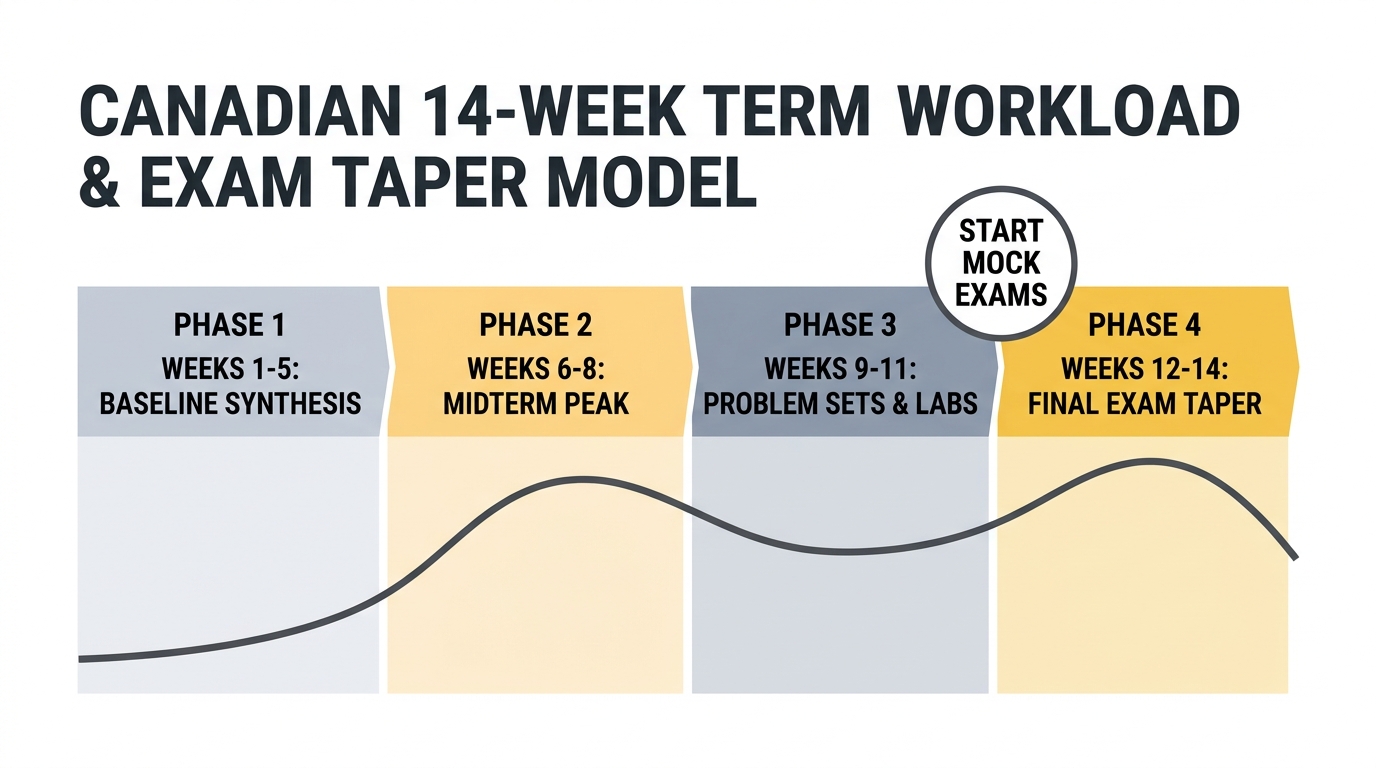
- Weeks 1–5 (Baseline Synthesis): Stick strictly to your evenly distributed planner blocks. Build clean summary sheets or spaced-repetition decks on the exact same day after lectures while examples are fresh, and check dense humanities reading assignments with the Reading Time Estimator so sixty-page seminar packets never catch you off guard.
- Weeks 6–8 (Midterm Cluster & Reading Week Bridge): Update your deadline dates inside the planner two weeks before your heaviest midterm sits so the algorithm temporarily shifts 45 to 55 percent of blocks toward imminent exams without dropping core quantitative maintenance in other classes.
- Weeks 9–11 (Term Papers & Lab Execution): Rebalance after Reading Week toward final lab reports, code milestones, and multi-draft research essays. Shift at least one afternoon block per week to office hours or writing-centre feedback.
- Weeks 12–14 (Final Exam Taper): Switch from passive note reading exclusively into full closed-book past paper simulations timed strictly to 120 or 180 minutes, preserving sleep on the two nights before each registrar-scheduled exam.
Active recall tactics by discipline: STEM vs. humanities & commerce
Identical 45-minute study blocks fail if every subject uses passive highlighting. Match your study block structure directly to how each Canadian university faculty examines you:
- Mathematics, Engineering, and Physical Sciences: Spend no more than 10 minutes reviewing formula derivations, then spend 35 minutes solving unseen textbook problems and past tutorial sheets strictly without peaking at solution manuals. Mark every step where you hesitated and re-test that exact problem archetype 72 hours later.
- Life Sciences, Psychology, and Nursing: Combine self-quizzing flashcards with blank-page pathway reconstruction (drawing metabolic cycles, cranial nerves, or renal filtration flows from memory before checking diagrams) so dense terminology links causally under multiple-choice pressure.
- Economics, Accounting, and Commerce Cases: Alternate quantitative balance-sheet or microeconomic optimization drills with structured 20-minute written memo outlines answering "why", "trade-offs", and "recommendation" cleanly.
- History, Political Science, and Literature: Summarize every weekly reading in three analytical claims plus primary evidence immediately after finishing the PDF—using the Standard GPA Calculator after midterms to measure how higher essay polish translates directly to cumulative transcript gains.
Using accessibility accommodations, tutoring centres, and Sunday re-planning
Every Canadian college and university funds peer writing centres, drop-in mathematics help rooms, and academic accessibility offices whose support multiplies the return on your study hours. Instead of staring helplessly at an impenetrable organic chemistry proof for ninety minutes inside an evening block, flag stuck concepts immediately and bring three targeted questions to a thirty-minute teaching-assistant office hour the next morning. Students registered with campus accessibility centres for extended exam time, quiet rooms, or assistive screen readers should also adjust block length from standard 45-minute intervals to whatever rhythm prevents cognitive fatigue.
Build one non-negotiable 15-minute reset habit every Sunday afternoon: clear completed assignments from last week, pull updated syllabus exam dates, shift weights up on whichever course dropped below your target mark on a recent lab or quiz, and export fresh weekly blocks for Monday morning. Treating the planner as a living weekly compass—not a frozen Week 1 contract—keeps stress steady even when midterms collide across four courses at once.
Managing bilingual (French/English) and honours thesis terms
Students enrolled in French-immersion streams, bilingual degrees at uOttawa or York Glendon, or fourth-year honours seminar capstones carry hidden cognitive switching costs that standard credit weighting undercounts. Translating dense primary articles or proofing specialized academic French prose consumes 25 to 40 percent more time per page than reading English lecture slides. Raising bilingual seminar difficulty weights from 3 to 4 inside the planner automatically carves out two extra weekly deep-reading sessions so terminology gaps never snowball ahead of mid-semester oral presentations.
Similarly, honours thesis students face open-ended literature reviews without weekly Canvas quizzes acting as guardrails. Treat each chapter draft milestone—proposal defence, ethics submission, data coding, and full rough draft—as a strict synthetic deadline date in the planner rather than letting thesis hours drift continuously behind urgent problem-set classes.
Sources
The research on distributed practice, retrieval practice, and interleaving is well-established and the primary references are listed below.
Sources
- Dunlosky, J., Rawson, K. A., Marsh, E. J., Nathan, M. J., & Willingham, D. T. Improving Students' Learning With Effective Learning Techniques: Promising Directions From Cognitive and Educational Psychology. Psychological Science in the Public Interest, 14(1), 4–58, 2013. journals.sagepub.com
- Roediger, H. L., & Karpicke, J. D. Test-Enhanced Learning: Taking Memory Tests Improves Long-Term Retention. Psychological Science, 17(3), 249–255, 2006. journals.sagepub.com
- Rohrer, D., & Taylor, K. The Shuffling of Mathematics Problems Improves Learning. Instructional Science, 35(6), 481–498, 2007. link.springer.com
- Ontario Ministry of Education. High School Graduation Requirements. ontario.ca/page/high-school-graduation-requirements
- Alberta Education. Diploma Exams. alberta.ca/diploma-exams
- Universities Canada. National Association of Canadian Universities. univcan.ca